
Contrôle coercitif – article 20min
Le contrôle coercitif, un phénomène encore trop méconnu, mais qui détruit des vies. Merci au journal 20 Minutes de mettre en lumière cette problématique et de revenir sur les efforts pour faire évoluer la loi en Suisse et mieux protéger les victimes.
📖 Article à lire ici : https://www.20min.ch/fr/story/suisse-les-tyrans-au-sein-des-couples-pourraient-etre-punis-par-la-loi-103306085
🔴 Comment la justice familiale met-elle en danger les victimes de violence domestique ?
Dr Emma Katz est une chercheuse britannique reconnue dont le travail met en lumière les conséquences du contrôle coercitif sur les enfants et les jeunes.
📄 Nous avons traduit son article “Contrôle coercitif, tribunal de la famille et thérapie systémique et familiale : une combinaison infernale” pour qu’il soit plus accessible à la communauté francophone.
Elle y montre comment :
- Les tribunaux familiaux minimisent la gravité du contrôle coercitif, imposant aux victimes des contacts forcés avec leur agresseur.
- Les décisions de justice privilégient souvent l’agresseur, en accusant les parents protecteurs (souvent les mères) d’”aliénation parentale”.
- Certains enfants sont contraints de suivre des thérapies pour “pardonner” leur agresseur, sous peine d’être séparés du parent qui tente de les protéger.
- Les juges, psychologues et travailleurs sociaux manquent de formation sur ces violences, ce qui les empêche de prendre des décisions réellement protectrices.
📢 Il est urgent de repenser la justice familiale pour protéger les enfants.
🔗 Article original en anglais : Lien
📄 Traduction en français : Lien
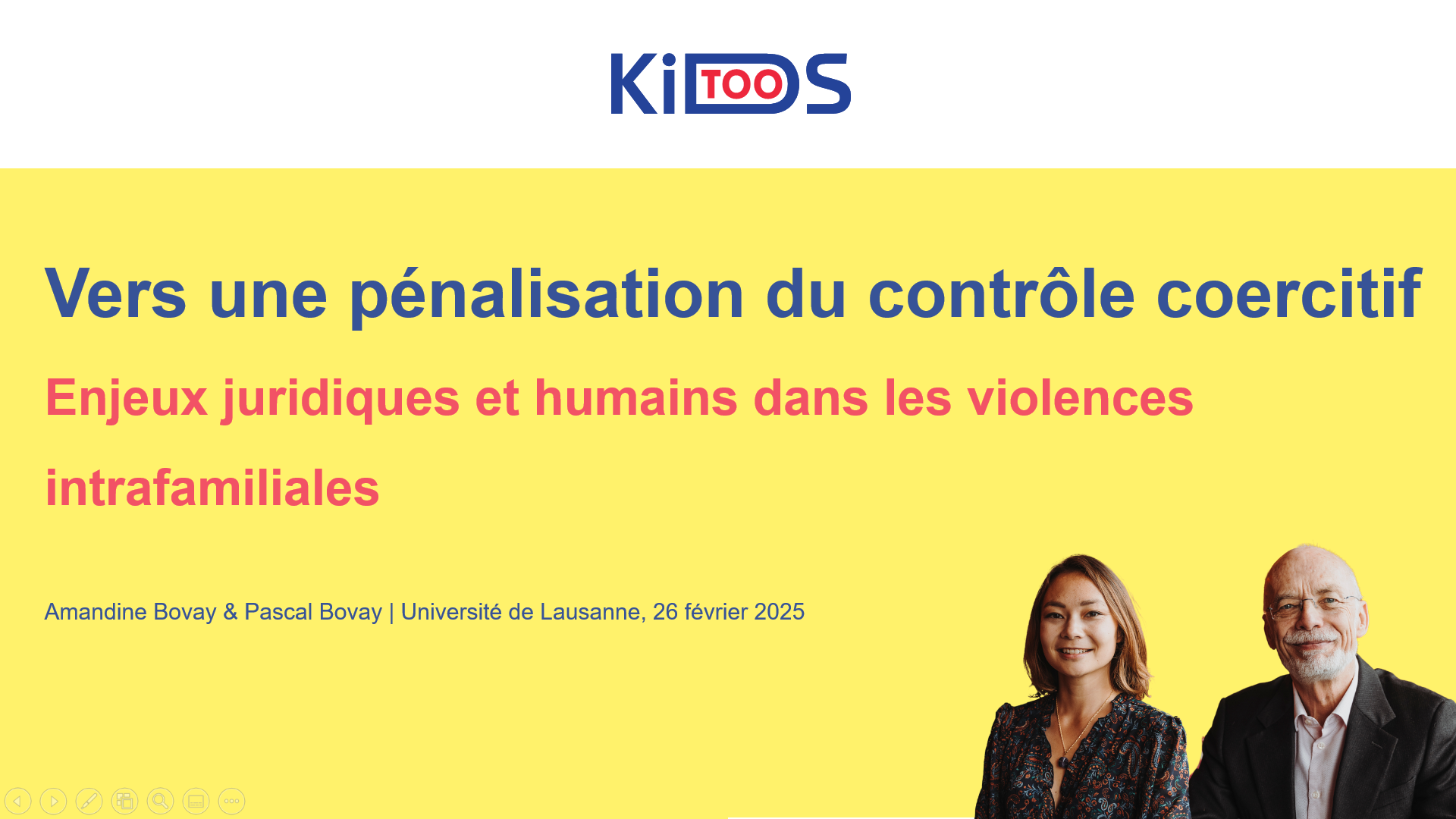
KidsToo a eu l’occasion d’intervenir dans le cours de droit pénal de l’Université de Lausanne pour une présentation intitulée « Vers une pénalisation du contrôle coercitif : Enjeux juridiques et humains dans les violences intrafamiliales ».
Un immense merci à la Professeure Perrier-Depeursinge pour cette opportunité précieuse d’échanger avec les étudiant·e·s en droit.
Sensibiliser et former les futurs acteurs judiciaires est essentiel pour mieux identifier, comprendre et lutter contre les mécanismes des violences intrafamiliales. Une justice informée est une justice plus protectrice.
Aujourd’hui, à 2 jours de la journée internationale des droits des femmes, Jacqueline de Quattro a déposé une motion demandant au Conseil fédéral d’élaborer une modification de la loi afin d’introduire la notion de contrôle coercitif dans le code pénal et le code civil.
Le contrôle coercitif inclut des comportements répétés et insidieux tels que l’imposition de règles strictes, le contrôle des ressources financières ou encore l’isolement social et psychologique. Ces comportements constituent un schéma de domination aux conséquences graves pour les victimes.
Lire la motion AUF DEUTSCH ➡️ https://www.parlament.ch/de/ratsbetrieb/suche-curia-vista/geschaeft?AffairId=20253062
L’introduction du contrôle coercitif dans la loi permettra de protéger davantage les victimes de violences domestiques qui sont principalement des femmes et des enfants.
Kidstoo collabore étroitement avec différents partenaires, dont les politiques, pour faire avancer les droits des victimes et principalement des enfants.

📢 Ein großer Fortschritt in Frankreich gegen häusliche Gewalt
🔹 Zwangskontrolle im Strafgesetzbuch verankert
🔹 Eine Reform des Zivilgesetzbuches, um Opfer und Kinder besser zu schützen
Die Nationalversammlung verabschiedete ein historisches Gesetz, mit dem Zwangsuntersuchungen in Frankreich endlich als Straftat anerkannt werden. Dieser Durchbruch ermöglicht :
✔️ Strenge strafrechtliche Sanktionen mit bis zu zehn Jahren Gefängnis und einer Geldstrafe von einer Million Euro. (Erschwerende Faktoren: Gewalt wird in Anwesenheit eines Kindes, von Arbeitsunfähigkeit, Behinderung und Schutzbedürftigkeit begangen)
✔️ Änderungen des Zivilgesetzbuches zum besseren Schutz von Opfern und Kindern: Berücksichtigung der Zwangskontrolle bei familiengerichtlichen Entscheidungen, Einschränkung oder Entzug des Besuchsrechts und der elterlichen Sorge im Falle einer Verurteilung.
Dies ist nur ein erster Schritt: Welche Herausforderungen sind noch zu bewältigen? 👇
Ein unumgänglicher Podcast über Zwangskontrolle bei innerfamiliärer Gewalt
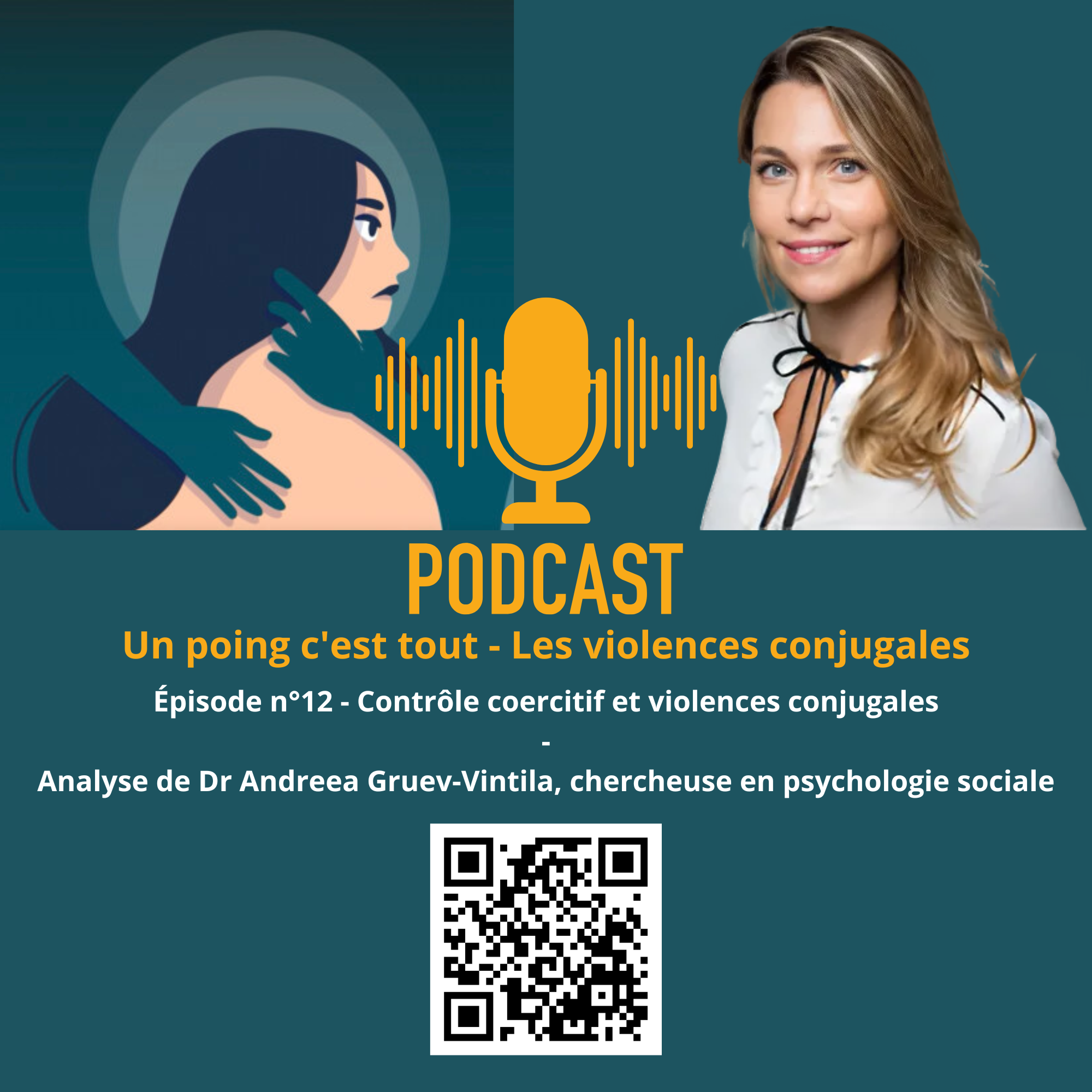
Dr. Andreea Gruev-Vintilă ist Forscherin im Bereich Sozialpsychologie und Maître de conférences HDR an der Universität Paris Nanterre. Sie ist international anerkannt für ihre Arbeit zu innerfamiliärer Gewalt, Geschlechterstereotypen und sozialen Normen. Im Jahr 2023 veröffentlichte sie das Schlüsselwerk “Coercive control: at the heart of domestic violence” (Zwangskontrolle: im Zentrum der häuslichen Gewalt), das weltweit zur Gestaltung der Gesetzgebung und Sensibilisierung beiträgt.
In dieser Episode des Podcasts “Eine Faust ist alles” antwortet Dr. Gruev-Vintilă am Mikrofon von Adrien Roland Boulogne. Sie befasst sich eingehend mit dem Konzept der Zwangskontrolle im Zusammenhang mit innerfamiliärer Gewalt und erläutert detailliert die psychologischen Mechanismen und sozialen Normen, die sie zu einer besonders heimtückischen Form von Gewalt machen. Sie geht insbesondere auf die Geschichte der Entwicklung dieses Konzepts im ehelichen Kontext, die gesetzgeberischen Herausforderungen und die weitreichenden Auswirkungen für die Opfer ein.
Unbedingt anhören (FR) HIER
Kindesmisshandlung ist empörend
Während sich das Jahr 2024 dem Ende zuneigt, blickt KidsToo auf ein Jahr voller Projekte und Verpflichtungen zurück.
Zu diesen Projekten gehört auch unser Kampf für die gesetzliche Verankerung von Zwangskontrollen.
Wir hatten das Glück, auf wertvolle Unterstützung zählen zu können, darunter die Nationalrätin Jacqueline de Quattro, die sich seit langem für den Opferschutz einsetzt. Sie äußert sich in diesem Blick-Artikel zu diesem Thema.
Die Arbeit wird im Jahr 2025 fortgesetzt. Wir werden unsere Anstrengungen verdoppeln, damit die Politiker unsere Stimme hören und dieses für den Schutz von Kindern und Opfern innerfamiliärer Gewalt lebenswichtige Postulat annehmen.
Vielen Dank an alle, die auf diesem langen Weg an unserer Seite gehen.
Children of Coercive Control
Summary:
The Coercive Control of Children extends Evan Stark’s path-breaking analysis of interpersonal violence to children, showing that coercive control is the most important cause and context of child abuse and child homicide outside a war zone, as well as of the sexual abuse, denigration, exploitation, isolation and subordination of children. The book provides a working model of the coercive control of children and illustrates its dynamics and consequences withdramatic cases drawn from the headlines and Dr. Stark’s forensic practice. The cases include those in which the coercive control of children runs in tandem with the coercive control of women, where children are “weaponized” in the coercive control of their mother and cases where abused mothers harm theirchildren to survive or protect them from worse. By highlighting a criminal cause of child maltreatment and a plausible justice response, Evan Stark challenges the common assumptions that child abuse and neglect fall on a continuum of problems rooted in maternal deficits, immaturity, poverty, and environmental stressors as well as the combination of Child Welfare and Child Protection Services that currently provide the ameliorative response….
Author: Evan Stark
Source: www.payot.ch
Coercive Control in Children’s and Mothers’ Lives
Summary:
Coercive control is a severe form of domestic violence experienced by millions of children worldwide. It involves a perpetrator using a range of tactics to intimidate, humiliate, degrade, exploit, isolate and control a partner or family member. Some coercive control perpetrators use violence, others do not.Drawing on interviews with children and mothers who have experienced coercive control-based domestic violence, this groundbreaking book sheds light on the impacts of coercive control on children, how it is perpetrators who must be held accountable for those impacts, and how resistance by children and mothers occurs. Resistance happens in everyday life, not just in response to incidents of violence. Breaking free from coercive control is not a one-off event but a sustained battle for safety and recovery in which child and adult survivors need supports and professional interventions that work.Written accessibly for students, researchers, practitioners, survivors of domestic violence, and anyone with a general interest in the topic, the book provides a child-centered perspective to revolutionize our understanding of how children are affected by coercive control-based domestic violence….
Author: Emma Katz
Source: www.payot.ch
A professional Guide
Summary:
This beautifully illustrated and sensitively written storybook and accompanying professional guide have been created to help young children understand about domestic abuse and coercive control. Floss is a happy little puppy who loves going to Doggy Daycare and playing with her best friend, Houdini. The story explores how things change when her Mum’s new friend, Boss, comes into their lives. Floss’s story supports children who have experienced domestic abuse and trauma as they make sense of their feelings, teaching them to seek help and stay safe. The supporting guidebook helps adults to work through the story effectively, putting the professional in a position to have important conversations with children about what to do if something at home does not feel right. This set: Can be used to address the topic of domestic abuse and coercive control with individuals, small groups and whole classes, enabling dialogue around a sensitive issue Offers activities for supporting children, safety planning strategies and guidance for taking on a key adult role Can be used to support the PSHE curriculum, particularly around the topic of healthy relationships This set is a vital tool for teachers, social care staff, therapists and other professionals working to teach young children about domestic abuse and coercive control. It provides an important vehicle for talking to children about staying safe and their emotional wellbeing.
Authors: Catherine Lawler, Abigail Sterne. Illustrated by Nicky Armstrong
Source: www.payot.ch