
🌟 La motion déposée par Madame la Conseillère Jacqueline de Quattro témoigne de son engagement en faveur des victimes de violences intrafamiliales.
Le contrôle coercitif est une forme de violence insidieuse, souvent invisible, pourtant dévastatrice. Elle constitue bien souvent le terreau sur lequel s’installent les violences conjugales les plus graves, parfois jusqu’au féminicide/homicide ou au suicide forcé.
Chez KidsToo, nous sommes convaincus que :
➡️ La sensibilisation du grand public à cette dynamique est essentielle.
➡️ Former toute la chaîne des intervenants – police, justice, santé, éducation, protection de l’enfance – est crucial pour pouvoir identifier, comprendre et agir face à ce type de violence.
➡️ Nous pensons également que l’introduction d’une infraction autonome dans le Code pénal, accompagnée de réformes au niveau du droit civil, est indispensable pour assurer une véritable protection des victimes, y compris les enfants.
Le débat actuel en France autour de cette question nous offre des enseignements précieux, que nous comptons utiliser pour rendre ce processus plus rapide et plus efficace en Suisse.
📄 Interview de Madame la Conseillère nationale Jacqueline de Quattro à lire dans le Blick :
https://www.blick.ch/fr/suisse/romande/controle-coercitif-avec-sa-nouvelle-motion-la-plr-jacqueline-de-quattro-repart-en-croisade-contre-les-violences-domestiques-id20744138.html
Contrôle coercitif – article 20min
Le contrôle coercitif, un phénomène encore trop méconnu, mais qui détruit des vies. Merci au journal 20 Minutes de mettre en lumière cette problématique et de revenir sur les efforts pour faire évoluer la loi en Suisse et mieux protéger les victimes.
📖 Article à lire ici : https://www.20min.ch/fr/story/suisse-les-tyrans-au-sein-des-couples-pourraient-etre-punis-par-la-loi-103306085
🔴 Comment la justice familiale met-elle en danger les victimes de violence domestique ?
Dr Emma Katz est une chercheuse britannique reconnue dont le travail met en lumière les conséquences du contrôle coercitif sur les enfants et les jeunes.
📄 Nous avons traduit son article “Contrôle coercitif, tribunal de la famille et thérapie systémique et familiale : une combinaison infernale” pour qu’il soit plus accessible à la communauté francophone.
Elle y montre comment :
- Les tribunaux familiaux minimisent la gravité du contrôle coercitif, imposant aux victimes des contacts forcés avec leur agresseur.
- Les décisions de justice privilégient souvent l’agresseur, en accusant les parents protecteurs (souvent les mères) d’”aliénation parentale”.
- Certains enfants sont contraints de suivre des thérapies pour “pardonner” leur agresseur, sous peine d’être séparés du parent qui tente de les protéger.
- Les juges, psychologues et travailleurs sociaux manquent de formation sur ces violences, ce qui les empêche de prendre des décisions réellement protectrices.
📢 Il est urgent de repenser la justice familiale pour protéger les enfants.
🔗 Article original en anglais : Lien
📄 Traduction en français : Lien
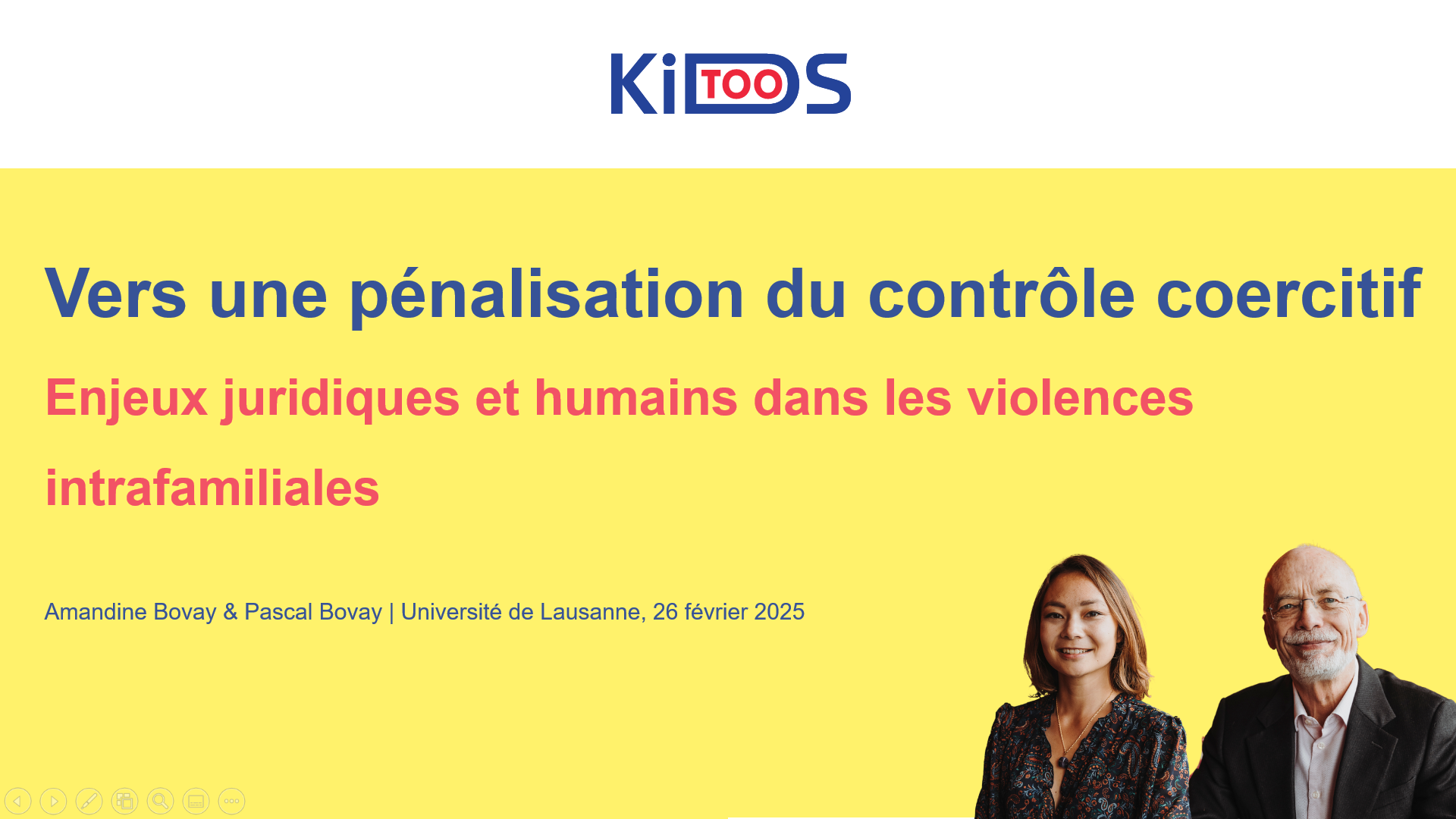
KidsToo a eu l’occasion d’intervenir dans le cours de droit pénal de l’Université de Lausanne pour une présentation intitulée « Vers une pénalisation du contrôle coercitif : Enjeux juridiques et humains dans les violences intrafamiliales ».
Un immense merci à la Professeure Perrier-Depeursinge pour cette opportunité précieuse d’échanger avec les étudiant·e·s en droit.
Sensibiliser et former les futurs acteurs judiciaires est essentiel pour mieux identifier, comprendre et lutter contre les mécanismes des violences intrafamiliales. Une justice informée est une justice plus protectrice.
Aujourd’hui, à 2 jours de la journée internationale des droits des femmes, Jacqueline de Quattro a déposé une motion demandant au Conseil fédéral d’élaborer une modification de la loi afin d’introduire la notion de contrôle coercitif dans le code pénal et le code civil.
Le contrôle coercitif inclut des comportements répétés et insidieux tels que l’imposition de règles strictes, le contrôle des ressources financières ou encore l’isolement social et psychologique. Ces comportements constituent un schéma de domination aux conséquences graves pour les victimes.
Lire la motion ➡️ https://www.parlament.ch/fr/ratsbetrieb/suche-curia-vista/geschaeft?AffairId=20253062
L’introduction du contrôle coercitif dans la loi permettra de protéger davantage les victimes de violences domestiques qui sont principalement des femmes et des enfants.
Kidstoo collabore étroitement avec différents partenaires, dont les politiques, pour faire avancer les droits des victimes et principalement des enfants.

📢 A major step forward in France against domestic violence
🔹 Coercive control enshrined in the Criminal Code
🔹 A reform of the Civil Code to better protect victims and children
The National Assembly has passed a landmark law that finally recognises coercive control as a crime in France. This step forward means that :
✔️ Severe criminal penalties, with up to 10 years’ imprisonment and a €1 million fine. (aggravating factors: violence committed in the presence of a child, incapacity for work, disability and vulnerability)
✔️ Amendments to the Civil Code to provide better protection for victims and children: inclusion of coercive control in family court rulings, restriction or withdrawal of visiting rights and parental authority in the event of conviction.
This is only the first step: what challenges remain? 👇
An essential podcast on coercive control in domestic violence
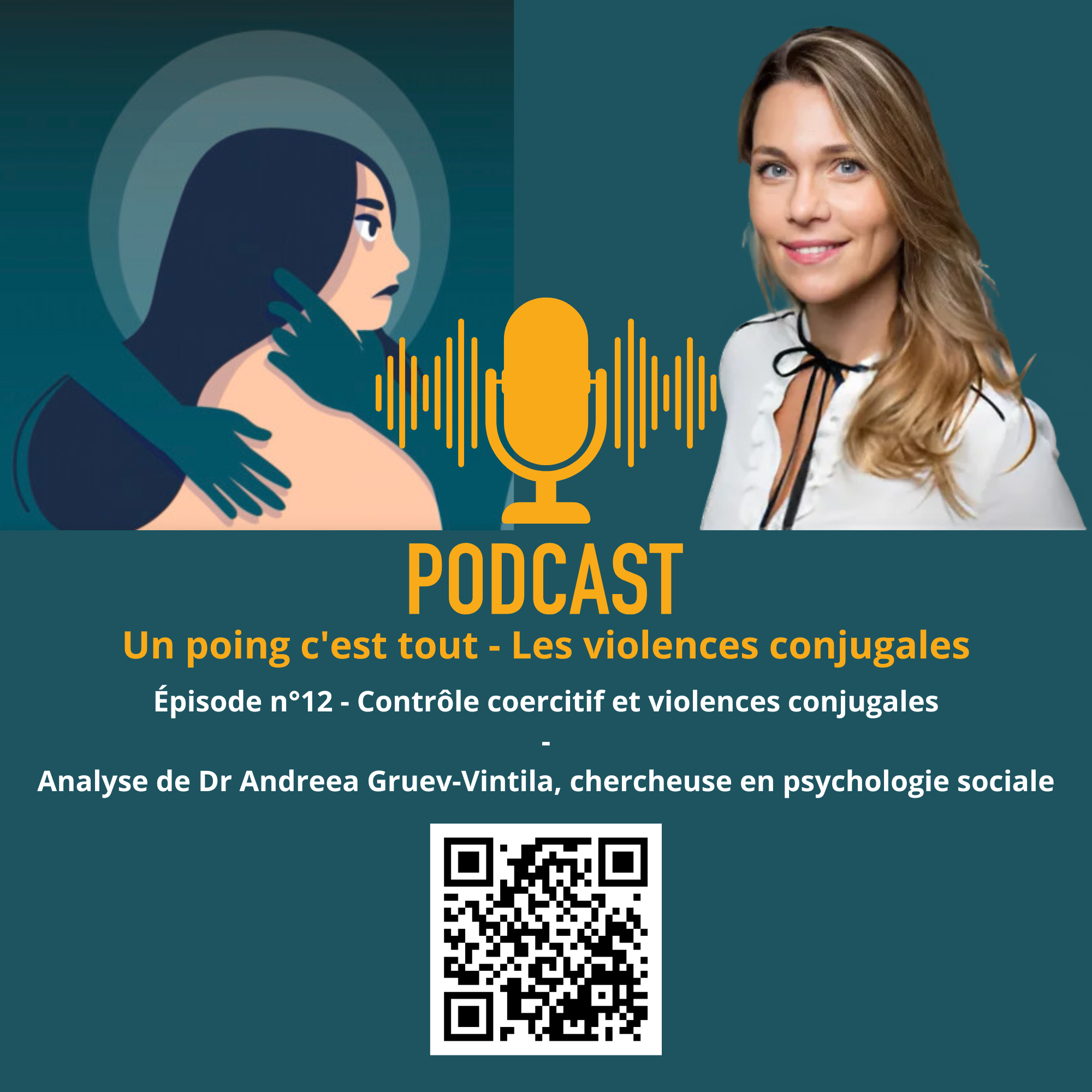
Dr Andreea Gruev-Vintilă is a researcher in social psychology and HDR lecturer at the University of Paris Nanterre. She is internationally recognised for her work on domestic violence, gender stereotypes and social norms. In 2023, she published a key work entitled “Coercive control: at the heart of domestic violence”, which is helping to shape legislation and raise awareness around the world.
In this episode of the podcast “Un poing c’est tout”, Dr Gruev-Vintilă talks to Adrien Roland Boulogne. She explores in depth the concept of coercive control in the context of domestic violence, detailing the psychological mechanisms and social norms that make it a particularly insidious form of violence. In particular, she discusses the history of the development of this concept in the marital context, the legislative challenges and the far-reaching implications for victims.
A must listen HERE
Child abuse is revolting
As 2024 draws to a close, KidsToo takes stock of a year rich in projects and commitments.
These projects include our fight to enshrine coercive control in law.
We were fortunate to be able to count on valuable support, including that of Jacqueline de Quattro, a National Councillor who has long been committed to protecting victims. She talks about this in this article in Blick.
The work continues in 2025. We will redouble our efforts to ensure that politicians hear our voice and accept this postulate, which is vital for the protection of children and victims of domestic violence.
Thank you to all those who are walking alongside us on this long journey.
Children of Coercive Control
Summary:
The Coercive Control of Children extends Evan Stark’s path-breaking analysis of interpersonal violence to children, showing that coercive control is the most important cause and context of child abuse and child homicide outside a war zone, as well as of the sexual abuse, denigration, exploitation, isolation and subordination of children. The book provides a working model of the coercive control of children and illustrates its dynamics and consequences withdramatic cases drawn from the headlines and Dr. Stark’s forensic practice. The cases include those in which the coercive control of children runs in tandem with the coercive control of women, where children are “weaponized” in the coercive control of their mother and cases where abused mothers harm theirchildren to survive or protect them from worse. By highlighting a criminal cause of child maltreatment and a plausible justice response, Evan Stark challenges the common assumptions that child abuse and neglect fall on a continuum of problems rooted in maternal deficits, immaturity, poverty, and environmental stressors as well as the combination of Child Welfare and Child Protection Services that currently provide the ameliorative response….
Author: Evan Stark
Source: www.payot.ch
Coercive Control in Children’s and Mothers’ Lives
Summary:
Coercive control is a severe form of domestic violence experienced by millions of children worldwide. It involves a perpetrator using a range of tactics to intimidate, humiliate, degrade, exploit, isolate and control a partner or family member. Some coercive control perpetrators use violence, others do not.Drawing on interviews with children and mothers who have experienced coercive control-based domestic violence, this groundbreaking book sheds light on the impacts of coercive control on children, how it is perpetrators who must be held accountable for those impacts, and how resistance by children and mothers occurs. Resistance happens in everyday life, not just in response to incidents of violence. Breaking free from coercive control is not a one-off event but a sustained battle for safety and recovery in which child and adult survivors need supports and professional interventions that work.Written accessibly for students, researchers, practitioners, survivors of domestic violence, and anyone with a general interest in the topic, the book provides a child-centered perspective to revolutionize our understanding of how children are affected by coercive control-based domestic violence….
Author: Emma Katz
Source: www.payot.ch